For Enterprise, Family Business & Government
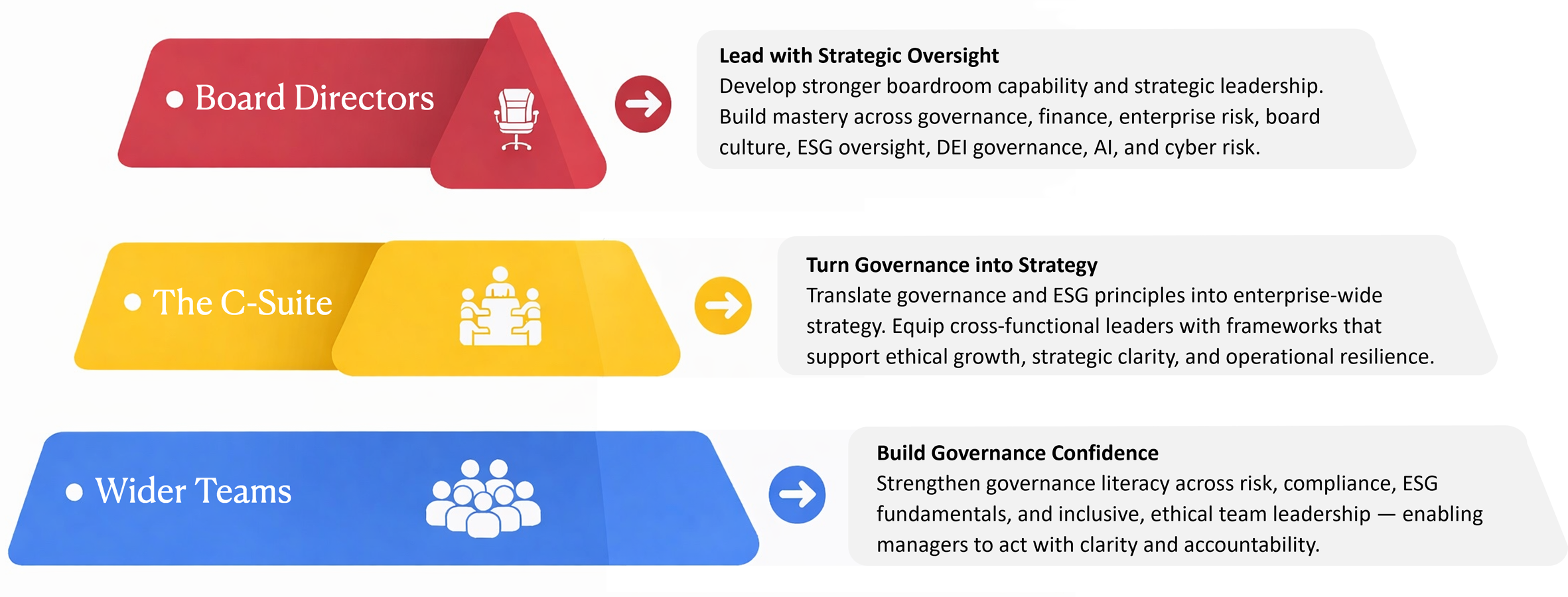
Governance & ESG development for your current board directors, the board leaders you need tomorrow, and the management teams that support them.
Turn governance into a strategic advantage that strengthens decision-making, resilience, and long-term performance and build future-ready governance capability across your organisation with tailored learning pathways for Board Directors, C-Suite Leaders, and wider management teams.
This enterprise program is offered through our partners:

Unlock your business potential
Trusted by thousands of learners in leading global companies:
_logo.svg.png "NHS")








Why choose The Global Board Institute for your enterprise, family business and government training in Governance topics?
Corporate governance is about staying prepared for what’s next, in an environment of shifting regulation, rising risk, stakeholder scrutiny, and increasing operational complexity, not just about ticking a regulatory box.
Global Board Institute enterprise learning moves leaders beyond theory. We deliver practical governance training shaped by world-leading practitioners, real-world case studies, and ready-to-use tools and frameworks that can be applied immediately. This scalable online model strengthens directors, executives, and managers alike.
We don’t just deliver governance courses. We develop confident, accountable leaders. With learners in 79 countries and independently rated programmes, we are a trusted global partner in boardroom effectiveness and executive leadership development.
Why corporate governance learning and development is important to all businesses today.
Strong governance capability leads to better strategic decisions, clearer oversight, stronger risk management, and long-term enterprise value creation. Investing in governance and ESG learning strengthens organisational resilience and stakeholder trust.
88% of investors consider ESG factors when making investment decisions.
Businesses with ESG-aligned strategies attract 3x more investment capital than those without.
Businesses with effective corporate governance structures report a 15% higher ROI.
Strong corporate governance leads to 23% higher profitability.
Companies with weak governance are 5x more likely to suffer from fraud, mismanagement or reputational damage.
Governance failures can reduce shareholder value by 30% or more.
Targeted learning for every level of leadership
Our online microlearning library and customizable pathways to effective learning are tailored for each level of leadership, focused on practical governance skills, strategic frameworks, and real-world boardroom application.

Microlearning library
Microlearning that Fits Executive Schedules and Scales Across the Business
Senior leaders need learning that delivers impact without disrupting performance. Our microlearning library offers 180+ focused lessons and 3,000+ minutes of expert-led content across corporate governance, ESG, strategy, risk, culture, AI, and board leadership. Each module is concise, practical, and immediately applicable in board and executive settings.
Built on proven learning principles such as spaced reinforcement, microlearning improves retention and accelerates knowledge activation. Short, structured sessions reduce cognitive overload while strengthening long-term recall and decision confidence.
Key benefits include:
- 10–15 minute lessons designed for busy executives
- Practical governance frameworks and real-world case insights
- SCORM-compliant LMS integration or hosted delivery
- Real-time progress tracking and enterprise analytics
The result is scalable, enterprise-ready governance training that embeds continuous leadership development across the organisation.
Curated learning pathways
Structured Programmes Aligned to Your Leadership Mandate
Select from 21 curated governance learning pathways that combine high-impact micro-lessons into structured, role-aligned leadership journeys. Each programme blends expert-led videos, case studies, governance scenarios, toolkits, masterclasses, and Q&A sessions, delivering practical, immediately applicable learning outcomes.
Board Oversight of AI: Strategic, Safe, and Compliant Use
- What Is Artificial Intelligence and Why It Matters to Leaders
- Why AI Governance Matters: Key Principles Every Leader Must Know
- Board-Level Responsibility for Ethical and Compliant AI Use
- Building an AI Governance Framework That Works
- The 12 Must-Have Elements of an AI Board Policy
- How to Structure AI Oversight Committees and Escalation Paths
- NIS2, EU AI Act and DORA: Global Regulatory Landscapes
- Establishing an AI Advisory Council and Independent Audit Trails
Digital Transformation Oversight for Boards
- Cloud Computing: What Every Leader Needs to Know
- Big Data Defined and Debunked
- Artificial Intelligence: Capabilities and Caveats
- Blockchain in Action: Supply Chains, Records, Transactions
- Robotic Process Automation (RPA) and What It Means for Your organisation
Cybersecurity for the Boardroom
- Cybersecurity for Boards: Getting the Basics Right
- Cyber Roles Across the Organisation: From CIO to Internal Audit
- Key Questions Boards Should Ask About Cybersecurity
- Cyber Risk Assurance: Audits, Experts and Frameworks
- Are You Incident Ready? Board-Level Cyber Crisis Planning
Strategic Oversight of CSRD for Directors
- Introduction to the Corporate Sustainability Reporting Directive (CSRD)
- Why CSRD Matters: Impacts on Strategy and Accountability
- Double Materiality Explained: Impact and Financial Perspectives
- Inside ESRS 1: Principles and Purpose of Sustainability Reporting
- Inside ESRS 2: Governance, Strategy and Risk in ESG Disclosure
- The Sustainability Statement: Format, Timing and Audit Requirements
Materiality and Governance Disclosure for Boards
- Materiality in Practice: From Identification to Assessment
- The Britvic Case Study: Embedding Materiality into Strategy
- Inside ESRS 2: Governance, Strategy and Risk in ESG Disclosure
- Governance Disclosures: Roles, Incentives, Risk and Due Diligence
- Reporting Exemptions and Transitional Relief under CSRD
Understanding the Role of the Company Secretary
- What is a Company Secretary?
- Corporate Governance and the Modern Company Secretary
- The Company Secretary's Role in Governance Compliance
- Expert Video Interview: The Expanding Role of the Company Secretary
- Webinar: Custodian of Governance – The Role of the Company Secretary
Governance Support: What to Expect from Your CoSec
- Duties and Responsibilities of a Company Secretary
- Governance Codes and the CoSec's Role in Implementation
- Supporting Directors in Disclosure and Reporting
- How the CoSec Adds Value to Board Effectiveness
- Chair–CoSec Relationship Best Practices
- Webinar: What Makes a Great Company Secretary
Boardroom Operations and Culture: CoSec's Influence
- Managing Board Schedules and Annual Work Plans
- CoSec Role in Induction, Succession and Training
- Supporting Board Evaluations and Performance Reviews
- Promoting Ethical Conduct and Boardroom Norms
- Discussion Forum: The Future of Corporate Governance
Governance Architecture: Building Effective Governance Structures
- Corporate Governance Architecture: The Essentials
- Board and Committee Structures Explained
- Case Study: Governance Architecture in Action
- Policy Development and the Governance Handbook
- Interactive: Designing a Board Structure
- Q&A: Best Practices in Governance Design
Finance for Board Members: Financial Oversight and Strategy
- Financial Statements 101 for Directors
- Key Financial Ratios and What They Mean
- Capital Allocation and Long-Term Value Creation
- Case Study: When Governance Failed Financially
- Audit Committee Responsibilities
- Q&A: CFO Insights for Board Directors
Board Handbook: Principles and Best Practices
- Principles of Good Corporate Governance
- Roles and Duties of Board Members
- Board Meetings and Decision-Making
- Case Study: Governance Failure & Lessons Learned
- Corporate Governance Codes and Regulations
- Q&A: Advice from a Seasoned Director
Board Diversity and Inclusive Governance
- The Case for Board Diversity (Instructional)
- Inclusive Governance Practices (Instructional)
- Regulatory & Investor Views on Board Diversity (Instructional)
- Case Study: Diversity Driving Better Decisions (Case Study)
- Building an Inclusive Board Culture (Instructional)
- Q&A: Experiences of a Diverse Director (Interview)
ESG Oversight for Boards
- Board's Role in ESG Governance
- ESG Governance Frameworks and Reporting
- Aligning ESG with Corporate Strategy (Board Perspective)
- Case Study: Board-Driven ESG Initiative
- Understanding ESG Metrics and Goals
- Q&A: Chairing an ESG Committee
Board Effectiveness and Continuous Improvement
- Conducting Board Evaluations
- Improving Boardroom Dynamics
- Succession Planning for the Board
- Case Study: Turning a Board Around
- Continuing Education for Directors
- Q&A: Effective Board Chair Techniques
Risk Oversight and Governance
- Enterprise Risk Management Overview
- Board's Role in Risk Oversight
- Risk Appetite and Strategic Alignment
- Case Study: When Risk Management Fails
- Emerging Risks: Cyber, ESG, and Beyond
- Q&A: Insights from a Risk Committee Chair
Strategic Governance and Value Creation
- Board's Role in Strategy Formulation
- Governance in the Strategic Planning Cycle
- Balancing Short-Term vs. Long-Term Goals
- Case Study: Governance Driving Strategic Success
- Aligning ESG Goals with Strategy
- Q&A: Board Strategy Workshop Insights
Technology and Cyber Risk Governance
- Technology Trends Impacting the Boardroom
- Cybersecurity Oversight for Boards
- Digital Transformation Governance
- Case Study: Cyber Breach – Board Response
- AI and Data Ethics in Governance
- Q&A: Boardroom Conversations on Tech
Regulatory Compliance and Governance
- Current Governance Regulations Overview
- ESG Reporting Standards (CSRD, SEC, etc.)
- Governance Policies for Legal Compliance
- Case Study: Consequences of Non-Compliance
- Staying Ahead of Emerging Regulations
- Q&A: Legal Perspectives for Directors
Emerging Trends in ESG and Corporate Governance
- The Evolving Corporate Governance Landscape
- New Frontiers in ESG (Climate, Human Capital, AI)
- Investor & Public Expectations Beyond 2025
- Case Study: A Leader in ESG and Governance Innovation
- Governance and ESG in a Digital World
- Q&A: Expert Predictions for Future Governance
Implementing ESG Strategy: Driving Sustainable Change
- Developing an ESG Strategy
- Aligning ESG with Business Goals
- Case Study: Successful ESG Integration
- Change Management for Sustainability Initiatives
- Webinar: Executive Panel on ESG Implementation
- Q&A: Pitfalls in ESG Execution
Stakeholder Engagement and Communication Strategies
- Identifying Stakeholders and Their Interests
- Case Study: Effective Stakeholder Engagement
- Communicating ESG Performance and Goals
- Media and Investor Relations 101
- Q&A: Handling Activist Investors and Public Scrutiny
- Webinar: Leading Through Transparency and Trust
Ethical Leadership & Corporate Culture
- Tone at the Top: Leadership and Ethics
- Building a Values-Driven Culture
- Case Study: Culture, Ethics, and Scandal
- Employee Engagement and Trust
- Interactive Scenario: Making Ethical Decisions
- Q&A: CEO Insights on Ethical Leadership
ESG Risks and Opportunities in Business Strategy
- Understanding ESG Risks (E, S, & G)
- Financial Implications of ESG Factors
- Case Study: An ESG Risk That Became a Crisis
- Innovating for Sustainability (New Opportunities)
- Scenario: Integrating ESG into Strategic Planning
- Q&A: Investor Perspective on ESG
Crisis Management and Resilient Governance
- Crisis Management Roles: Board vs Management
- Case Study: Board Leadership in a Crisis
- Communication in Crisis Situations
- Resilience Planning and Recovery
- Scenario: Simulated Crisis Response Exercise
- Q&A: Lessons from a Crisis
AI Strategy and Risk: Executive Decision-Making in a Transformative Age
- Generative AI: What It Is and How It Works
- How GenAI Models Are Trained, Tuned and Improved
- Organisational Benefits of AI: Efficiency, Accuracy, and Innovation
- The Risks of AI: Ethics, Bias, and Real-World Failures
- Risk Management for AI: Ethical, Operational, and Regulatory Risks
- Creating a Risk-Aware Culture Around AI
- The AI Lifecycle: Secure Design, Deployment and Ongoing Governance
- Defining Risk Appetite and Tolerance for AI Use
Leading Digital Transformation from the C-Suite
- Understanding the Internet of Things (IoT)
- Cloud in Practice: Tools You Already Use
- Why Big Data Matters: Predictive Analytics and More
- How AI Is Used Across Sectors Today
- Where RPA Works: Business Cases and Cautions
Executive Cyber Risk and Resilience
- The Three Lines of Defence Model in Cyber Risk Management
- Cyber Roles Across the Organisation: From CIO to Internal Audit
- Cyber Risk Assurance: Audits, Experts and Frameworks
- Are You Incident Ready? Board-Level Cyber Crisis Planning
Implementing CSRD Across the Business
- Who Must Report: CSRD Applicability and Thresholds
- Building Blocks of ESRS 1: Due Diligence, Value Chain, Reporting Periods
- Reporting Principles: Accuracy, Comparability, and Stakeholder Needs
- Minimum Disclosure Requirements: Policies, Actions, Metrics and Targets
- How to Build a CSRD-Aligned Sustainability Report
Strategic Alignment of ESG and CSRD
- Why CSRD Matters: Impacts on Strategy and Accountability
- Strategy Disclosures: Linking ESG to Business Models and Stakeholders
- IRO Disclosures: Managing ESG Impacts, Risks and Opportunities
- Environmental Standards Overview: ESRS E1 to E5 Essentials
- Social and Governance Standards: S1–S4 and G1 Explained
Leveraging the Company Secretary as a Strategic Advisor
- The Company Secretary's Strategic Influence
- Governance Compliance and Executive Accountability
- Effective Executive-CoSec Collaboration
- Preparing for Board and Committee Presentations
- The CoSec's Role in Crisis and Risk Scenarios
Risk and Compliance for Company Secretaries
- Understanding Risk in a Governance Context
- The Company Secretary's Role in Regulatory Compliance
- Supporting Board Risk Committees
- Escalating Risk to the Board: When and How
- Case Study: Governance Failures
- Emerging Trends in Corporate Governance
Communicating with Stakeholders and the Board
- Preparing Board Briefings and Papers
- Coordinating Stakeholder Disclosures
- Communication Protocols with Board and Committees
- Managing Investor Relations Documents
- Confidentiality, Sensitivity and Transparency
- Handling Board Questions and Follow-Ups
Governance for Executives: Working Effectively with the Board
- Corporate Governance Basics for Executives
- Board Expectations and Reporting
- Case Study: Executive–Board Misalignment
- Effective Board Presentations and Communication
- Navigating Board Committees as an Executive
- Q&A: CEO Perspective on Board Relations
Implementing ESG Strategy: Driving Sustainable Change
- Developing an ESG Strategy
- Aligning ESG with Business Goals
- Case Study: Successful ESG Integration
- Change Management for Sustainability Initiatives
- Webinar: Executive Panel on ESG Implementation
- Q&A: Pitfalls in ESG Execution
Stakeholder Engagement and Communication Strategies
- Identifying Stakeholders and Their Interests
- Case Study: Effective Stakeholder Engagement
- Communicating ESG Performance and Goals
- Media and Investor Relations 101
- Q&A: Handling Activist Investors and Public Scrutiny
- Webinar: Leading Through Transparency and Trust
ESG Risks and Opportunities in Business Strategy
- Understanding ESG Risks (E, S, & G)
- Financial Implications of ESG Factors
- Case Study: An ESG Risk That Became a Crisis
- Innovating for Sustainability (New Opportunities)
- Scenario: Integrating ESG into Strategic Planning
- Q&A: Investor Perspective on ESG
Crisis Management and Resilient Governance
- Crisis Management Roles: Board vs Management
- Case Study: Board Leadership in a Crisis
- Communication in Crisis Situations
- Resilience Planning and Recovery
- Scenario: Simulated Crisis Response Exercise
- Q&A: Lessons from a Crisis
Risk Oversight and Governance
- Enterprise Risk Management Overview
- Board's Role in Risk Oversight
- Risk Appetite and Strategic Alignment
- Case Study: When Risk Management Fails
- Emerging Risks: Cyber, ESG, and Beyond
- Q&A: Insights from a Risk Committee Chair
Strategic Governance and Value Creation
- Board's Role in Strategy Formulation
- Governance in the Strategic Planning Cycle
- Balancing Short-Term vs. Long-Term Goals
- Case Study: Governance Driving Strategic Success
- Aligning ESG Goals with Strategy
- Q&A: Board Strategy Workshop Insights
Technology and Cyber Risk Governance
- Technology Trends Impacting the Boardroom
- Cybersecurity Oversight for Boards
- Digital Transformation Governance
- Case Study: Cyber Breach – Board Response
- AI and Data Ethics in Governance
- Q&A: Boardroom Conversations on Tech
Regulatory Compliance and Governance
- Current Governance Regulations Overview
- ESG Reporting Standards (CSRD, SEC, etc.)
- Governance Policies for Legal Compliance
- Case Study: Consequences of Non-Compliance
- Staying Ahead of Emerging Regulations
- Q&A: Legal Perspectives for Directors
Emerging Trends in ESG and Corporate Governance
- The Evolving Corporate Governance Landscape
- New Frontiers in ESG (Climate, Human Capital, AI)
- Investor & Public Expectations Beyond 2025
- Case Study: A Leader in ESG and Governance Innovation
- Governance and ESG in a Digital World
- Q&A: Expert Predictions for Future Governance
Ethical Leadership & Corporate Culture
- Tone at the Top: Leadership and Ethics
- Building a Values-Driven Culture
- Case Study: Culture, Ethics, and Scandal
- Employee Engagement and Trust
- Interactive Scenario: Making Ethical Decisions
- Q&A: CEO Insights on Ethical Leadership
AI Fundamentals for Managers: Driving Efficiency, Reducing Risk
- What Is Artificial Intelligence and Why It Matters to Leaders
- Deep Learning: The Brains Behind AI's Intelligence
- Generative AI: What It Is and How It Works
- Real-World Business Applications of AI Across Functions
- The Risks of AI: Ethics, Bias, and Real-World Failures
- Explainability, Fairness, and Security in AI Systems
- Understanding AI Risks
- Embedding Ethics and Culture in AI Deployment
Digital Fundamentals for Managers
- Understanding the Internet of Things (IoT)
- The Cloud Stack Explained: SaaS, IaaS, PaaS & Serverless
- Key Benefits of Cloud Computing for Your Organisation
- Big Data in Practice: From Banking to Supply Chains
Cyber Awareness and Responsibility for Managers
- Cybersecurity for Boards: Getting the Basics Right (framed for broader use)
- Cyber Roles Across the Organisation: From CIO to Internal Audit
- The Three Lines of Defence Model in Cyber Risk Management
CSRD Essentials for Functional Managers
- Introduction to the Corporate Sustainability Reporting Directive (CSRD)
- Who Must Report: CSRD Applicability and Thresholds
- The Sustainability Statement: Format, Timing and Audit Requirements
- Reporting Principles: Accuracy, Comparability, and Stakeholder Needs
Supporting CSRD Reporting in Practice
- Materiality in Practice: From Identification to Assessment
- Building Blocks of ESRS 1: Due Diligence, Value Chain, Reporting Periods
- Minimum Disclosure Requirements: Policies, Actions, Metrics and Targets
- How to Build a CSRD-Aligned Sustainability Report
Core Responsibilities of the Company Secretary
- What is a Company Secretary?
- Evolution of the Company Secretary's Role
- Duties and Responsibilities of a Company Secretary
- Corporate Governance and the Modern Company Secretary
- Corporate Laws and Governance Codes
- The Company Secretary's Role in Governance Compliance
- Key Principles of Corporate Governance
- Expert Video Interview: The Expanding Role of the Company Secretary
Minuting with Impact
- Purpose and Importance of Minutes
- Drafting Clear and Concise Board Minutes
- Legal Requirements and Standards for Minuting
- Handling Sensitive or Controversial Discussions
- Digital Tools and Minute-Taking Technology
- Common Pitfalls and How to Avoid Them
Running Effective Board and Committee Meetings
- Planning the Board Agenda
- Coordinating with the Chair and CEO
- Supporting Committees and Working Groups
- Managing Pre-reads and Document Distribution
- Meeting Logistics and Virtual Meeting Tools
- Follow-Up, Action Logs, and Meeting Records
Managing Boardroom Dynamics
- Understanding Boardroom Power Dynamics
- Working with Difficult Personalities
- Supporting Constructive Debate and Challenge
- Confidentiality and Communication Norms
- CoSec as Board Culture Gatekeeper
- Conflict Resolution Techniques
Strategic Thinking for Company Secretaries
- The Company Secretary's Strategic Influence
- Translating Strategy into Board Practice
- Stakeholder Alignment and Communication
- Identifying Strategic Risks and Opportunities
- Expert Interview: Strategy and the CoSec Role
Governance Technology Essentials
- Digital Board Portals: Features and Selection
- Cybersecurity Basics for Governance Professionals
- AI and Automation in Board Administration
- Managing Digital Voting, Signatures, and Approvals
- Record-Keeping Compliance in a Digital World
Corporate Governance 101 for Managers
- Introduction to Corporate Governance
- Key Governance Principles and Terminology
- Roles and Responsibilities in Governance
- Case Study: A Governance Success Story
- Q&A: Why Governance Matters at All Levels
- Corporate Governance and Organizational Structure
Risk and Compliance Essentials for Managers
- Fundamentals of Risk Management
- Compliance and Internal Controls 101
- Case Study: A Compliance Lapse
- Building a Risk-Aware Culture
- Q&A with a Compliance Officer
- Ethics and Code of Conduct for Managers
ESG Essentials for Middle Management
- Introduction to ESG for Managers
- Corporate Sustainability Goals and You
- Case Study: Environmental & Social Initiatives in Practice
- Diversity & Inclusion Basics for Team Leaders
- Q&A: Overcoming ESG Implementation Challenges
- Case Study: A Small Change, Big Impact
Inclusive and Ethical Team Leadership
- Ethical Decision-Making for Managers
- Building an Inclusive Team Culture
- Case Study: The Impact of Inclusive Leadership
- Unconscious Bias in the Workplace
- Q&A: Fostering Ethics and Inclusion
- Leading by Example: "Tone at the Middle"
Download the enterprise brochure or request a tailored demo to explore how our governance training can support your organisation.
Enterprise Certifications & Cohort-Based Programmes
You can also offer your teams structured certifications in Corporate Governance, ESG, and Company Secretary practice through flexible, self-paced enterprise programmes designed for scale.

Build boardroom-ready governance expertise.

Lead sustainable strategy & reporting.

Master compliance & board operations.
Enterprise-Ready, Practical, and Flexible

Ready to transform your organisation?
Drive meaningful change and turn good governance into a competitive advantage with our tailored solutions.
Book your free demo today.
Schedule a consultation with our team to explore how GBI’s enterprise training can empower your leaders and drive organisational success.
Browse these questions and answers to help your research
Organisations of all sizes and industries benefit from GBI’s corporate training programmes. Whether you’re looking to upskill your team in a specific area of corporate governance or provide enterprise-level training for your board of directors, our solutions are fully customisable to meet your goals and current level of expertise.
Enterprise training is fully customisable based on your business needs. Choose from our extensive library of specialised modules to build your unique learning pathway. From Culture and Risk Management to ESG, our corporate training consultants are here to guide you through your options and help you design a programme that aligns with your specific objectives.
GBI’s training content is crafted by expert practitioners and global leaders in corporate governance and ESG. Informed by real-world business challenges, our solutions prioritise flexibility and customisation. Whether you choose a pre-defined learning pathway or build a unique programme from our library of modules, GBI’s content is designed to deliver high-impact outcomes for your organisation.
Our training is structured to fit your team’s schedule, with flexible online learning delivered through GBI’s Learning Management System. Depending on the selected pathway, participants will learn from expert speakers, interactive exercises and engaging course materials.
Assessment methods vary depending on your selected modules and organisational needs. Please contact us to discuss your training requirements and learn more about assessment options.
GBI provides comprehensive technical and learning support throughout your training experience.
